
Wait, is this actually Champagne?
Sparkling Wine 101 - and why you're allowed to be a snob sometimes...

I try so very hard not to be a nuisance about the wine I drink. Sure, I can be picky when I am the one with the wine list making decisions, but if I’m being gifted, given, or poured wine I will drink whatever is put in my glass (especially if I’m not paying, I mean come on… I’m not a monster). However, I have developed a pet peeve after some time in this profession, and it has to do with my favorite kind of wine. Perhaps I’m so bothered simply because it has to do with my favorite kind of wine. I know I’m not alone in this, and thankfully casual drinkers of the world are starting to care about it too. It must be said: I do not consider myself a wine snob, and I go out of my way to condemn wine snobbery. With all those caveats out of the way, I will bare my soul to you now.
Ok, here goes…
Just because wine is carbonated, that does not mean it is Champagne.
Now don’t get me wrong, there is a lot of Champagne out there. (300 million bottles of it are produced every year - about the same as Napa Valley and Sonoma combined). But just because you see bubbles in the glass, that doesn’t automatically make the wine Champagne. There are dozens of regions across the globe that produce wine with bubbles, and each one has its own unique rules, grapes, terroir, and customs surrounding their wine culture. This month, we’re diving into the two most popular - what makes them unique, well-known producers, how much to spend, and their quirks. Plus a few bonus regions at the end, where your dollar really stretches at the wine shop.
Champagne
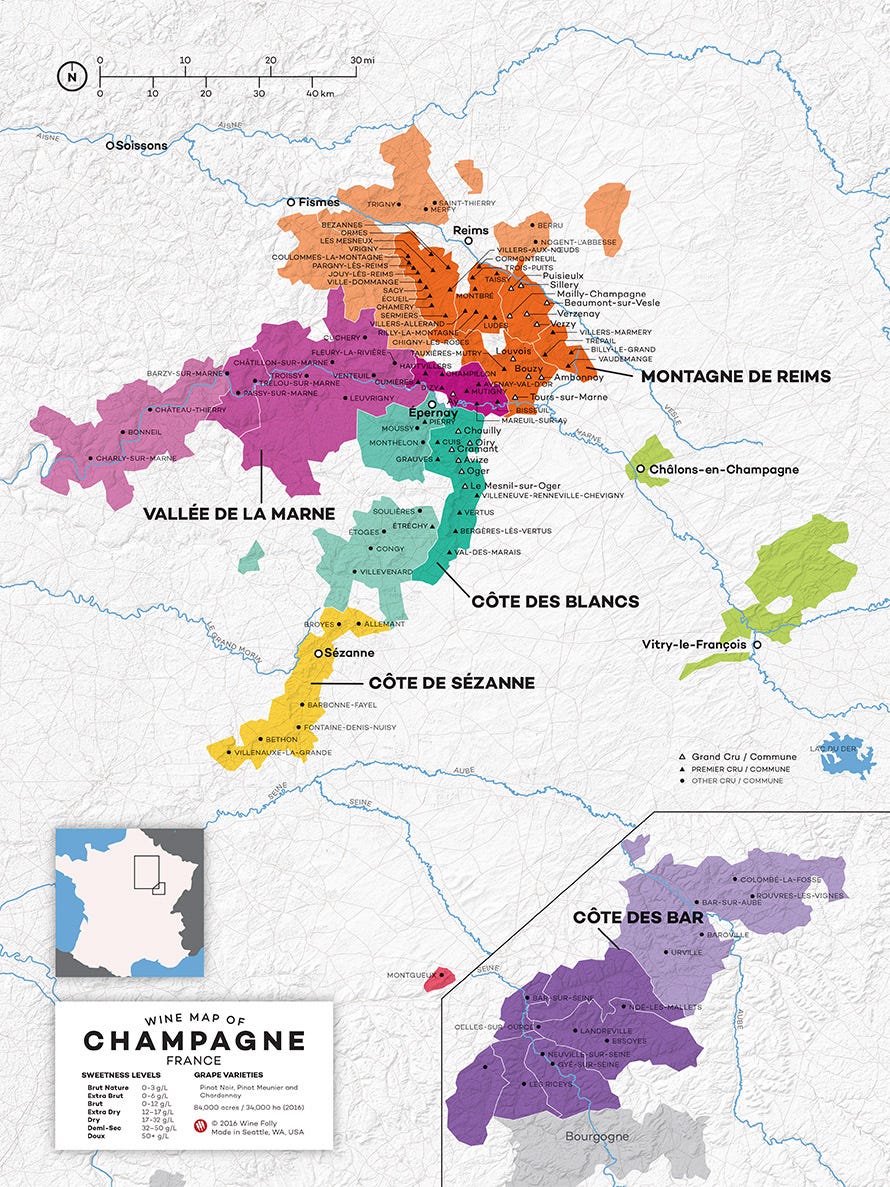
In a small region of Northern France, about a 90-minute drive from Paris, lies a collection of ~300 villages and 85,000 acres of vineyard land dedicated to the production of the world’s most famous sparkling wine: Champagne. You have by now heard the rule: “You can’t call it champagne unless it comes from Champagne, France. Otherwise, it’s sparkling wine.” Technically that is correct (Wine is geography after all), but it is extremely reductive.
Champagne, like all French wine regions, comes with a set of specific rules that must be followed in order for wine to be called “Champagne.” Some of those rules are:
Wines must be white or rosé sparkling wines.
Wines must be made from the following grapes: Arbane, Chardonnay, Meunier, Petit Meslier, Pinot Blanc, Pinot Gris, and Pinot Noir.
Grapes used for winemaking must come from hillsides within designated villages.
Agricultural qualifications - how many grapes can be harvested, how closely together grapevines can be planted, how frequently you can irrigate, etc.
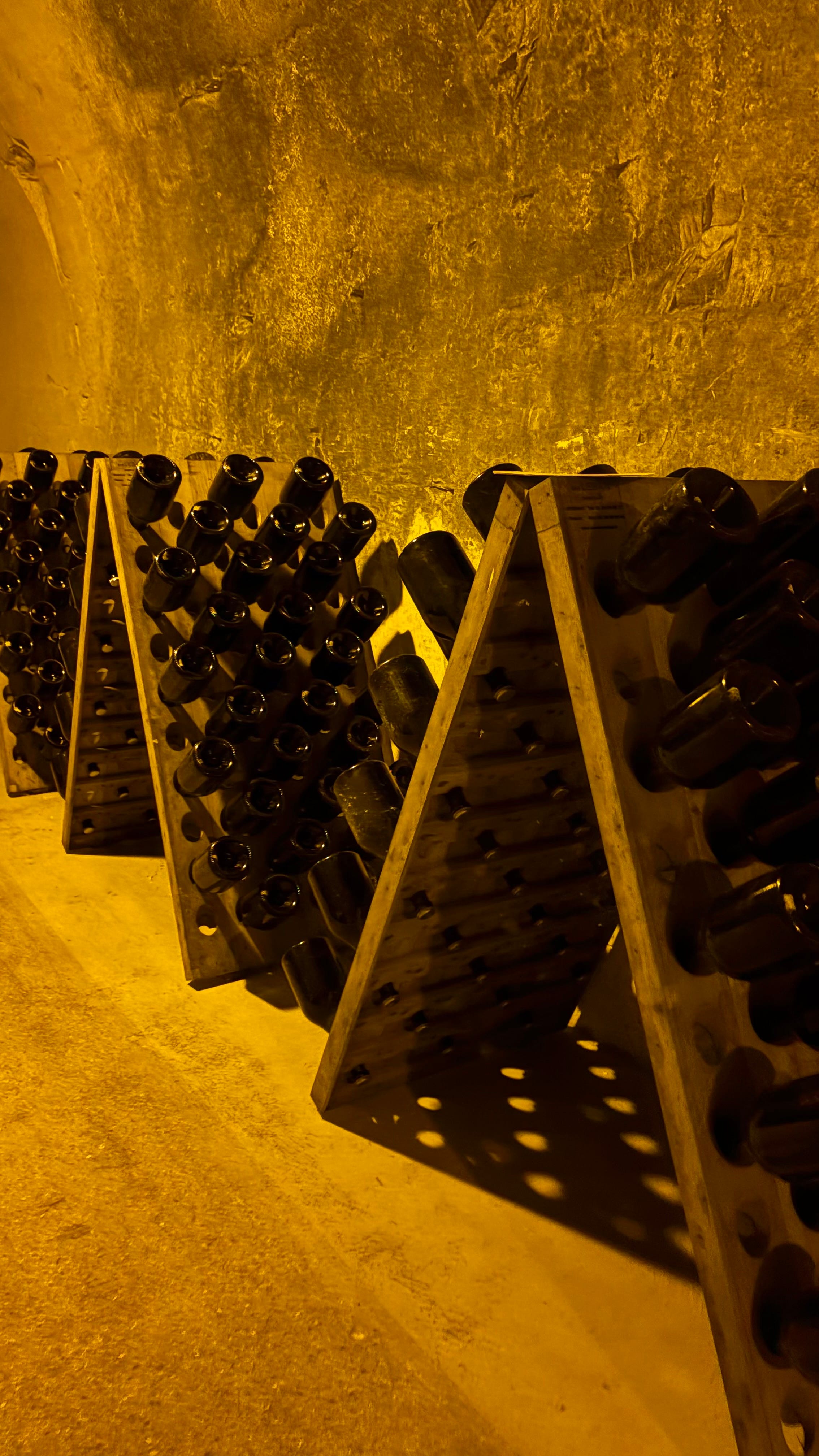
And most importantly - The wines must be exclusively produced by a second fermentation in glass bottles; a process that is known as “Traditional Method or Champagne Method / Méthode Traditionnelle or Méthode Champenoise”. This process is what gives the wine its characteristic notes of brioche/toasted bread and depth of flavor.
Wines with “Champagne” on the label carry higher value and better name recognition, so much so that in 1936 it became illegal to use the word if winemakers did not follow the above specifications.
Most recently, in 2021, Champagne officials sparked international trade disputes with Russia because of a new law allowing for the word “Shampanskoye” to be used on Russian sparkling wine. They thought it was too close to their protected “Champagne.” Talk about Cocorico!
Champagne’s popularity, branding, and market dominance come with a price in the wine aisle. Expect to spend $45-65 (and unfortunately sometimes much more) on a bottle of good Champagne. Try finding Grower Champagne - a term for smaller producers that make their own wine rather than selling off their grapes to the mass-production luxury houses like Moët & Chandon, Veuve Clicquot, Madame Pommery, Perrier-Jouët, etc.
The name of the game is consistency. Champagne-makers aim to have their wines taste identical every vintage. Veuve Clicquot wants the bottle you got as a gift ten years ago to taste the same every other time you buy it. The goal is to build brand loyalty - you find the one you like and can trust it for every celebration forever. It definitely works for them, I mean if it was up to me I’d drink Krug Grande Cuvée every day for the rest of my life - sadly, my bank account disagrees.
Prosecco
Ahh Prosecco. For the longest time touted as the value-lover’s Champagne, the everyday bubbles. I admit I tend to find myself the most disappointed when the “glass of Champagne” I’m handed at an event ends up being Prosecco. And that isn’t even because Prosecco is bad! It’s because carbonation is just about the only thing the two wines have in common.
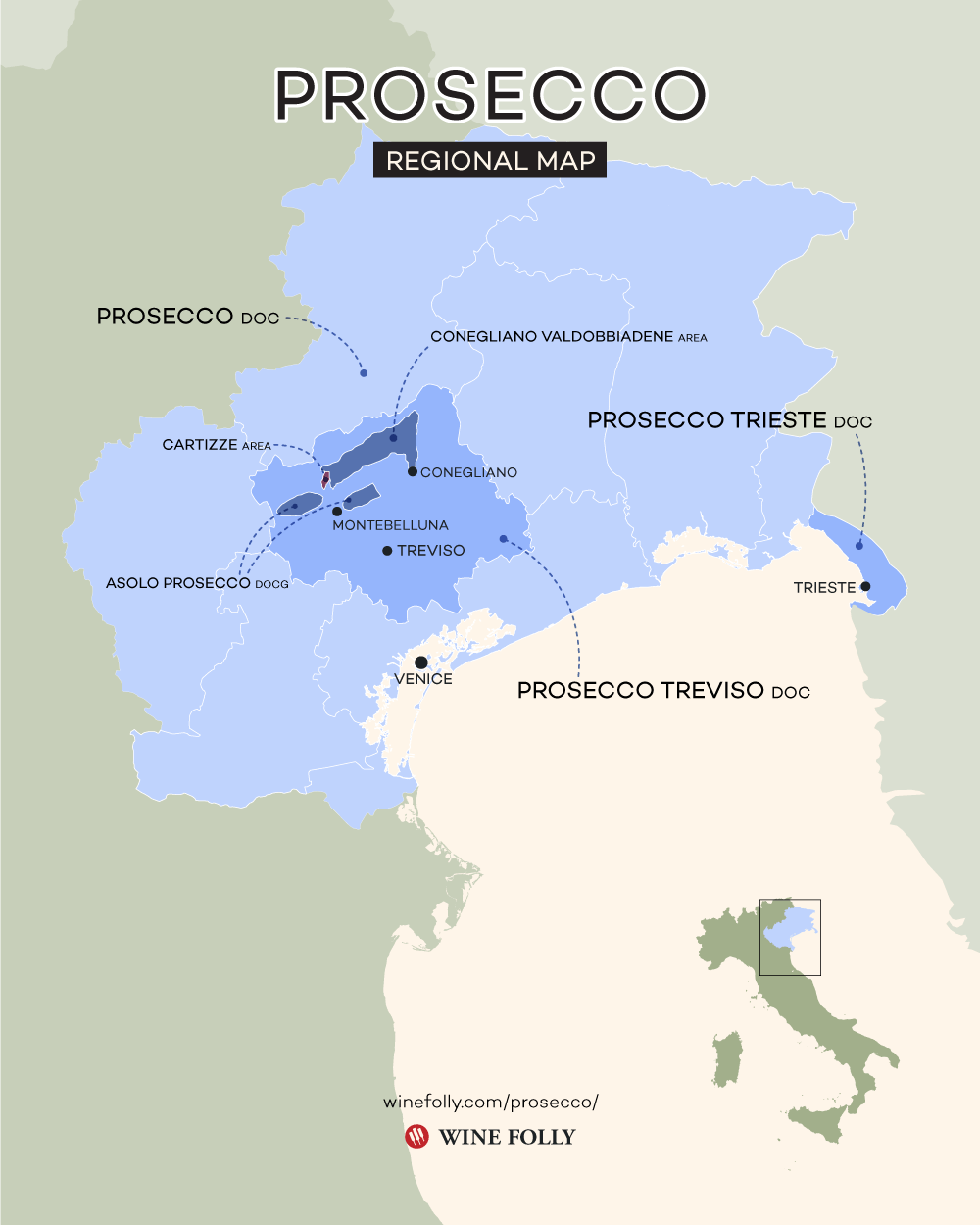
Prosecco is made in the Northern Italian region of the Veneto using Glera - a small-berried white grape that grows exclusively in this area. It is typically made using the Charmat (or Tank) Method, where the secondary fermentation (when CO₂ is dissolved into the wine) happens in massive stainless steel vats.
The Charmat method is relatively inexpensive, meaning Prosecco tends to cost less. However it also lacks the briochey, toasted bready richness that Champagne lovers enjoy. By contrast, Prosecco tends to have a fresher, more fruit-dominated taste and is meant to be drunk young (and often).
Some of the most famous Prosecco producers are La Marca, Mionetto, and Amandi, huge international brands that are found at every store in America. There are also smaller family producers, such as Ca’ dei Zago and Casa Coste Piane, that make extremely high-quality wine from the region that is worth seeking out. You can expect to spend around $20-30 for a bottle of really great Prosecco, and even less if you plan to throw it into a Mimosa.
Other Noteworthy Sparkling Wines
Cava - Tasty value-driven wines made in the Catalonia region in Northeast Spain. Wines can be white or rosé and must be made from the grapes: Macabeo, Parellada, Xarel-lo, Chardonnay, or Malvasia. Inexpensive (under $20) and crushable, but don’t expect the complexity or depth from other regions - at least not yet (they’re getting there though).
Franciacorta - Produced in the Lombardy region of Northern Italy, this wine is the real deal. Grapes include: Chardonnay, Pinot Blanc, and Pinot Noir, and (like Champagne) all grapes must be harvested by hand. The quality and care rival some top Champagnes and are well worth seeking out. Ca’ del Bosco and Bellavista are some of the most famous, and prices range from $25-45 for good bottles.
Crémant - Label nomenclature that highlights the true pedantics of French wine. Crémant is any Traditional Method sparkling wine made in France, but not in Champagne. Crémant d’Alsace and Crémant de Loire are some of the most famous and best. Price and quality can vary, but look for producers you recognize for their still wine, and try their sparkling - there are some cool surprises out there!
American Sparkling Wine - Because the U.S. has no strict legal requirements for sparkling wine grapes or production method, quality and price can vary. $25-30 can usually secure you a good bottle of U.S. bubbly. Famous U.S. sparkling wine producers include: Schramsberg, Roederer Estate, Domaine Carneros, and Gruet (which actually produces wine in New Mexico).
The U.S. government (with cooperation from the French) actually allows wineries established on or before March 2006 to label their wines “Champagne” so long as they include geographic origin as well (i.e., California Champagne, Oregon Champagne, etc.).
A glass of sparkling wine is one of my favorite things, if that wasn’t obvious, and I’m certainly partial to a nice Champagne. But delicious bubbles are being made all over the world, and the best part - it doesn’t have to be saved for special occasions. Now more than ever you can get a bottle of bubbs for cheap to bring to your next birthday, anniversary, work party, or - why the hell not - just a Wednesday night.
“Venez vite, je goûte les étoiles!”
[Come quick, for I am tasting the stars.]
—Brother Dom Pierre Pérignon, said supposedly after inventing Champagne, August 4, 1693
jp